

What is the Direct Aid Program?
The Direct Aid Program (DAP) is a flexible small grants program through which the Australian Government supports development projects that contribute to sustainable economic growth and poverty reduction.
The Australian High Commission in Port of Spain administers DAP in the Caribbean.
Eligible organisations
Government entities, multilateral organisations, intergovernmental organisations, NGOs and local government organisations engaged in development activities on a not-for-profit basis in the countries listed below are eligible for funding under DAP:
Belize
Dominica
Grenada
Guyana
Haiti
Jamaica
St Lucia
St Vincent and the Grenadines
Suriname
Any changes made to the project scope or approved budget must be approved by the High Commission. Failure to seek prior approval will result in a breach of the contract and all unapproved expenditure will need to be repaid.
What projects are eligible?
DAP activities should primarily be aimed at achieving practical and tangible outcomes of high development impact. DAP is able to fund activities that have a direct, practical and immediate impact, including capacity building in the areas of governance and human rights engagement. In 2026-27, we favourably consider projects that focus on:
- addressing community health challenges and non-communicable diseases (NCDs) e.g. health screening services, public health campaigns, sporting projects with a public health benefit
- improving access to safe water and levels of sanitation and hygiene in communities e.g. water tanks/systems, sanitation facilities.
- promoting climate change adaptation and mitigation strategies, strengthened resilience and sustainable environmental practices e.g. protection of coral reefs, sustainable fishing, sustainable agricultural practices etc.
- improving access to education e.g. provision of furniture for classrooms, facilities for schools, school community gardens etc.
- reducing disaster risk, including by reducing exposure to hazards, reducing vulnerability of persons or property and improving preparedness and early warning.
Preference will be given to projects where:
- applicants and beneficiary communities make a contribution to activities in terms of labour, materials, transport or cash
- the project might act as a catalyst for additional development of the community or a model for similar developments
- they empower women and girls, youth, Indigenous communities, people with disabilities or other marginalised groups.
The following expenses are NOT eligible for funding:
- cash grants or micro-credit schemes or any project that involves the return of money
- staff salaries for implementing organisations
- commercial ventures
- rent or purchase of land
- purchase of major assets e.g. vehicles or fuel
- routine, recurring running costs and administrative expenses including: office rental and utility costs not directly related to project implementation, spare parts, routine maintenance and repairs (including of equipment such as photocopiers, computers, stoves, fridges etc.) and office or equipment insurance
- catering
- accommodation
- Australian overseas study tours
- transport, including international travel, taxis and vehicle hire
- sponsorship of major sporting tournaments or cultural displays that do not have clear development outcomes
What is the funding limit?
There is no minimum amount that a single DAP project can receive but the maximum is AUD100,000 over the life of the project.
Activities may run for a maximum of two years (with funding allocated in the first year).
Application checklist
- a detailed budget
- quotations for all items listed in the budget
- a detailed project timeline
- for NGOs: a copy of your NGO registration
- for projects involving children or contact with children: the organisation’s Child Protection Policy, or code of conduct (if one does not exist, the applicant must create one)
- for infrastructure projects: proof of land ownership (copy of land title/lease) or a letter of permission from the landowner
- for first-time applicants: a financial statement for last financial year
- for projects exceeding AUD30,000 or 12 months: a risk management strategy
How are applications assessed?
The High Commission assesses applications against the following criteria:
- the project meets the requirements of DAP
- the project aligns with the identified themes
- the project has achievable and sustainable development outcomes
- the cost of the project relative to the development outcomes
- the completeness of the project application
- the practicality of the project’s implementation arrangements
During the assessment process, the High Commission may seek further information from the applicant.
Next steps
If you would like further information about the application process, please call the High Commission during business hours on +1 868 235 7950, or email the High Commission at [email protected].
Examples of DAP Projects
Belize
Australia has supported DAP projects in Belize since 2008, with beneficiaries such as a village within the Maya Golden Landscape in southern Belize.
Inga alley cropping is a sustainable alternative to slash and burn that increases food security, income, and resilience to climate change while promoting conservation of forest, soil and water to rural farmers in the MGL of southern Belize.
The Ya’axche Conservation Trust received DAP funding to provide training sessions to farmers in the establishment of Inga demonstration plots; prepare and establish 8 Inga demonstration plots; source and plant Inga seeds. Farmers learned how to retain soil fertility, moisture, and be more productive, and this gave them an opportunity to become more socially and ecological resilient, especially to the impacts of climate change.
Dominica
Australia has been supporting DAP projects in Dominica since 2005. A recent project involved Youth in Agriculture Cocoa Farm School which used DAP funding to provide training to forty-five youth between the ages of 18 and 35 years in practical and theoretical cocoa producing sessions over a three-month period. Composting training is also a key component of the course, as International standards require low cadmium levels in cocoa beans as a requirement for import.
At the end of training, participants learned how to create a cocoa nursery and demonstration plot which are critical aspects to increasing the production of high-quality cocoa beans.
Guyana
Australia has been supporting DAP projects in Guyana since 2009. RE NEW TT, an NGO dedicated to providing access to energy for resource-poor rural communities in the Caribbean, is a recent beneficiary.
RE NEW TT received DAP funding to install a solar-powered water pump in the Indigenous community of St Cuthbert’s in Region 4 of Guyana, providing over 1200 households with access to clean, safe water. Solar-powered lighting was also installed at St Cuthbert’s Primary School, providing students with a well-lit learning environment.
RE NEW TT also used DAP funding to train community members to install and maintain the new solar systems, ensuring sustainability of the project.
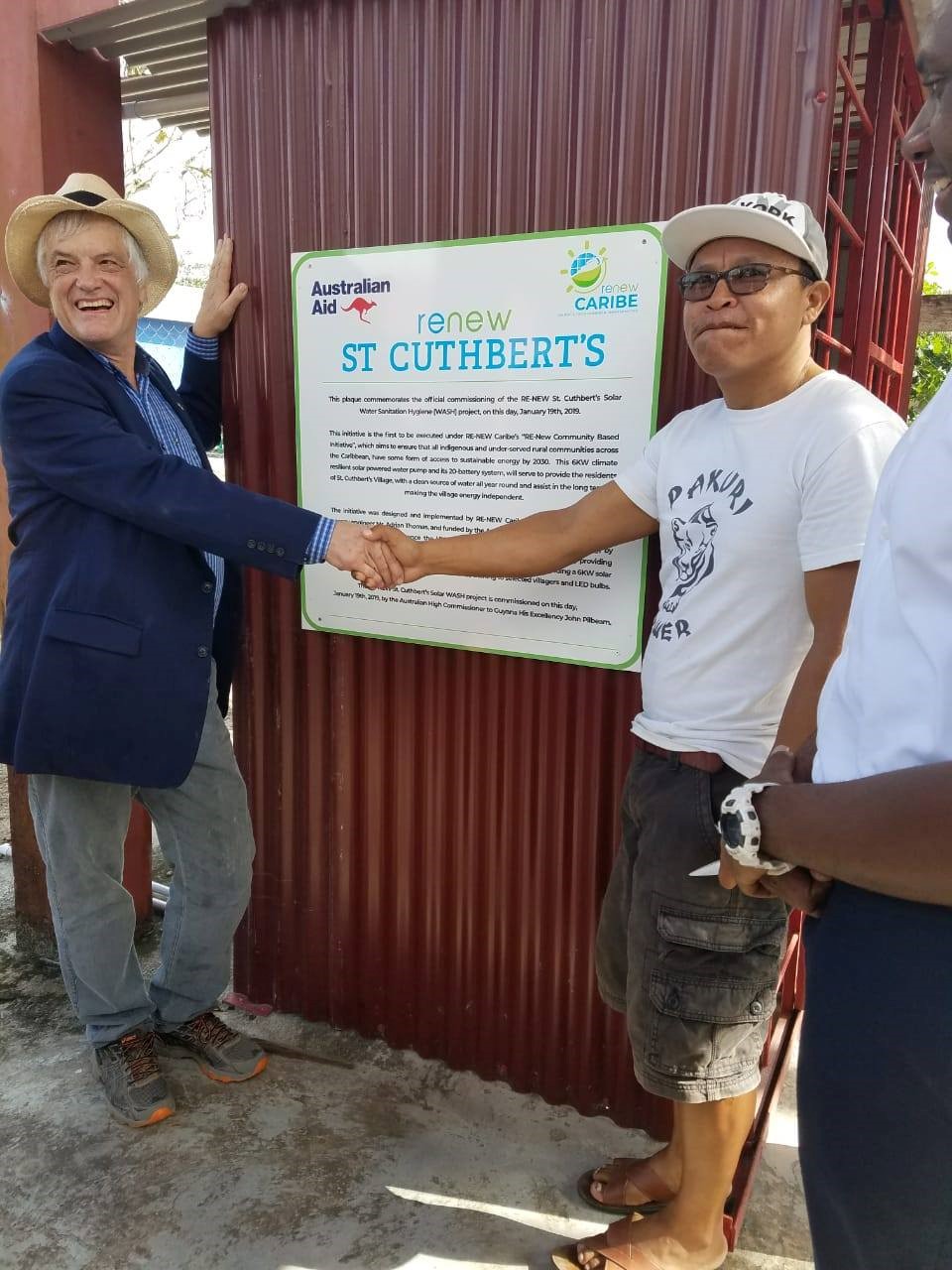
St Cuthbert's water tower where new DAP-funded Former Australian High Commissioner John Pilbeam and Deputy Tashao solar panels are mounted. Clenkian at the opening of RE NEW TT DAP-funded project in St Cuthbert's.
Jamaica
Australia has been supporting DAP projects in Jamaica since 2005. Montego Bay Marine Park Trust (MBMPT) is a recent beneficiary.
MBMPT recognised that residents’ activities in the Marine Park were having a negative impact on the reef’s ecosystems and a behaviour change was needed to improve the reef’s health.
MBMPT received DAP funding to conduct educational outreach in nearby secondary schools, purchase scuba, culling, diving and monitoring equipment for conservation efforts and to support local initiatives to control the population of the invasive lionfish.
Saint Lucia
Australia has been supporting DAP projects in St Lucia since 2005. The National Council of and for Persons with Disabilities (NCPD) is a recent beneficiary.
Due to high rates of physical disability and amputations in St Lucia, a solution was required to improve the mobility of people with disabilities.
NCPD received DAP funding to establish a Wheelchair Repair Centre in Vieux Fort and Prosthetic Rehabilitation and Repairs Centre in Castries. NCPD used the funding to train their staff and purchase tools and equipment to repair wheelchairs and construct and repair prosthetic limbs.
Since establishment, the Wheelchair Repair Centre has repaired over 30 wheelchairs and the Prosthetics Rehabilitation and Repairs Centre has constructed or repaired over 17 prosthetic limbs.
Suriname
Australia has been supporting DAP projects in Suriname since 2009. Stichting Support Recycling Suriname is a recent beneficiary.
The organisation used DAP funding to promote recycling by implementing its Suriname Clean! Upper Suriname Region project in 22 villages and schools along the Suriname river. It installed recycling bins for the collection of plastic bottles and aluminium cans, organised the collection of recyclables and raised awareness through educating students of primary schools in the villages.
In 12 months, 1,980 kilograms of plastic recyclable material was collected, which equates to approximately 59,400 plastic bottles.
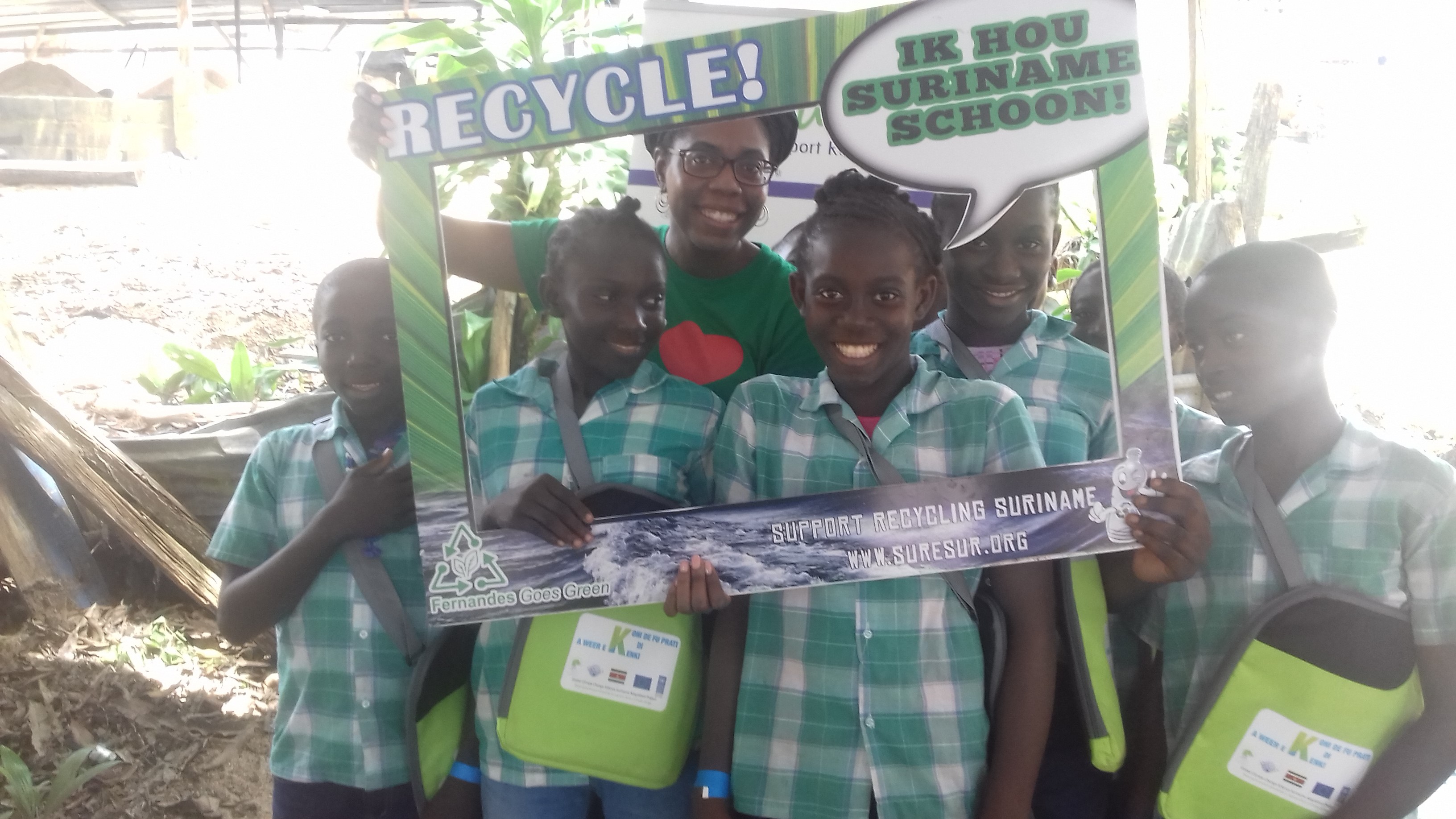 Students of a participating primary school learning the importance of recycling.
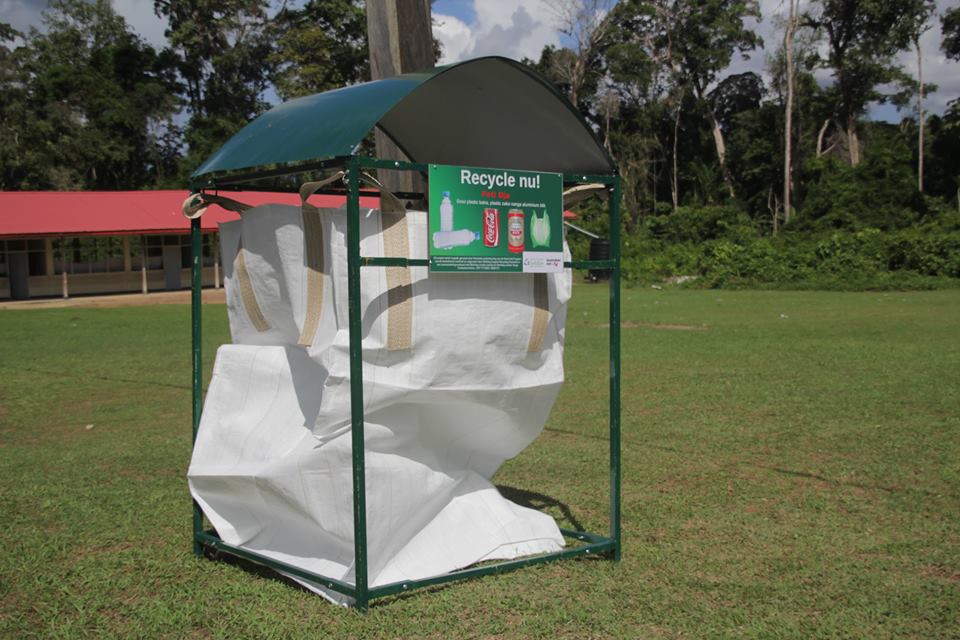 A recycling bin used for the collection of plastic bottles and aluminium cans.